Traumatic 1914 Christmas Eve and Life After
It was Christmas Eve 1914 in Sturgis. Marguerite, Edith and Rose Holtz were returning home from a Christmas program at the German Lutheran Church.
“And were as happy a group of children as could be found anywhere in Sturgis,” wrote a Sturgis Journal reporter.
Apparently the sisters were walking near the railroad tracks at the West Street crossing as they headed to their home at 219 N. Jacobs Street.
The reporter continued, “Two freight trains were switching at the West Street crossing and the girls were unable to see the approach of the passenger train.
Miss Marguerite slipped in her hast to cross and fell directly in front of the oncoming train.” The reporter continued, “Two freight trains were switching at the West Street crossing and the girls were unable to see the approach of the passenger train. Miss Marguerite slipped in her hast to cross and fell directly in front of the oncoming train.”
Her older sister pulled Marguerite from the track but not in time to entirely avert the disaster. The little girl’s foot was run over by the train.
They took her home, not too far away, and three Sturgis physicians arrived – Drs. Moe, Robinson and Watkins. The seven-year-old’s foot was amputated above the ankle.
The reporter added, “The family has much to be thankful for as the girls might very easily have all been killed.”
A few days later the community got a printed update on Miss Marguerite.
“Dr. Fred Robinson, who is attending Marguerite Holtz, the little girl who had her foot taken off by the G. R. & I. train Christmas eve, reports that she is getting along very nicely and that she will be able to sit up within a few days,“ he wrote.
John Holtz, her father, called the newspaper office to report that a representative of the railroad called on the young lady at her home this morning. He expressed gratitude to all who had been so kind to their family.
Still the story continues highlighting Sturgis community support for this little girl. By February 1915 the paper reported that W.A. Cavin and Attorney Theo Jacobs took on the case and “the railroad company gave the matter their immediate attention and settled the case in such a satisfactory way as to cause the entire of Sturgis to rejoice,” he reported.
The railroad company paid $3,000. The attorneys gave $500 to the family for housing and $500 to be used in “putting Marguerite where she can run and play like other children,” he said. “The balance, $2,000, will be invested in the highest interest gilt edged paying bond that Mr. Cavin can find on the market.” That was for her education.
I discussed this story with Dianne Gorsuch who told of a museum visitor who remembers seeing each of her prostheses hanging on the garage wall as she out grew each and another was made.
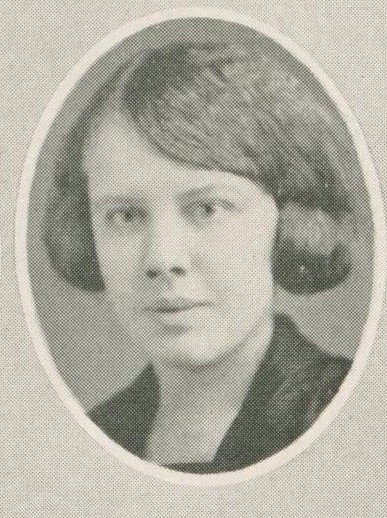
After writing the story I was curious and found Marguerite Holtz in the Sturgis High School class of 1925. The quote by her name reads, “For she was just the quiet kind whose nature never varied.”
When I put it on the Sturgis Museum Facebook page, Lois Holtz commented that Marguerite was her husband’s aunt, lived in Sturgis her whole life and is buried in Oak Lawn Cemetery.
I called Charles and Lois Holtz and he shared some memories of his aunt. Her name was Minna Marguerite. She would go by either name. In 1932 she married “Hank” (James Henry) Hart. They had no children.
Charles’ family lived near them on N. Orange Street. When he was young, Charles’ father died. His mother didn’t have a car but Aunt Marguerite would drive them to church. She was very nice and would sometimes take them out to eat, he said. She worked in the office of Harvey Paper Company, a major manufacturer in Sturgis for decades.
Her wooden leg was fascinating to Charles and his younger brother who would tap on her legs to see which one was wooden. Sometimes he got it right, Charles said. He did not remember the prosthesis hanging in the garage but seeing them in an attic.
Lois prompted Charles to tell about “I’ve Got a Secret,” a 1950s TV game show. Marguerite decided to share her “secret.” She had found a mouse inside her wooden leg. Unfortunately she never got on the show, Charles said.
Then Charles brought up the name Cavin, the man who worked with the lawyer to get the money from the railway company and invested it for Marguerite.
W.A. Cavin was the employer of her father – Charles’ grandfather.
Charles’ grandfather held such high regard for Cavin that he named his son William Cavin Holtz. It was Charles’ father born in 1910 even before Cavin worked with the lawyer to get the support Marguerite needed.
Now I want to learn more about W. A. Cavin. These town ancestors are so interesting.